How to Fill In the European Accident Statement (EU Form)
The European Accident Statement is one sheet for two vehicles. Each driver completes their own column, both mark the circumstance boxes in the middle, one of them draws a sketch, and both sign. The signatures confirm the facts recorded, not who was at fault. Insurers across Europe accept the form, and rental companies expect it after any damage.
This guide shows the real form pin by pin, explains the legal status of each part from the form's own directions and from the insurers' federation that issues it, and sets out what rental companies require afterwards. If you are at the roadside now, start with the step-by-step accident guide.
Key Takeaways
- The form follows one pattern approved by the European insurers' federation (CEA, now Insurance Europe); the 15 boxes are numbered identically in every language (CEA directions for use).
- Signing "does not constitute an admission of liability, but a summary of identities and the facts" (form footer, box 12).
- Insurance Europe calls it "perfectly safe" to complete and sign, provided you keep a copy bearing the other party's signature (Insurance Europe).
- Box 12 has 17 circumstance boxes and a counter for the number marked; the counter prevents later additions (ECC France).
- Rental companies require the completed form and often a police report: Sixt requires a police report "in all cases", Hertz Greece wants the form within 48 hours (Sixt, Hertz).
What is the European Accident Statement?
A standardised accident report created by the Comité Européen des Assurances, the European insurers' federation now called Insurance Europe. National insurers print it in their own language with the same layout and numbering, so two drivers without a common language can complete one document (ECC France brochure). The form carries a CEA copyright line and states that it "must be signed by both drivers" (CEA pattern form).
Its legal weight differs by country:
| Country | Local name | Legal footing |
|---|---|---|
| France | Constat amiable d'accident automobile | Not compulsory; the claim must reach the insurer within the contract deadline, which cannot be shorter than 5 working days under art. L113-2 Code des assurances (Groupama) |
| Italy | Modulo CAI (constatazione amichevole) | Art. 143 Codice delle Assicurazioni Private: drivers must report the accident to their insurer on the approved form; a form signed by both drivers is presumed accurate unless the insurer proves otherwise (Brocardi) |
| Spain | Declaración amistosa de accidente | Industry standard; the iDEA app sends it to both insurers (MAPFRE) |
| Germany | Europäischer Unfallbericht | Voluntary record; GDV supplies it free in 22 languages (GDV) |
| Netherlands | Europees schadeformulier | Voluntary (ANWB) |
| Austria | Europäischer Unfallbericht | Voluntary; for damage-only accidents the police need not be called if the parties prove their name and address to each other (RIS, §4 StVO) |
| Belgium | Constat européen d'accident | Voluntary; police must be called if anyone is injured (Ethias) |
"Amiable" means the two drivers record the facts jointly. It does not mean agreement on fault.
What does the form look like?
One A4 sheet with a carbon copy, so both drivers leave with the same page. Boxes 1 to 5 across the top are shared. Vehicle A takes the blue column, vehicle B the yellow one, and each column repeats boxes 6 to 11 and 14. Box 12 (circumstances) sits in the middle, box 13 (sketch) below, box 15 (signatures) at the bottom.
Interactive form
The real form, box by box
Tap any numbered pin on the form, or let the guide walk you through all 15 boxes in the order you fill them in. Arrow keys move between boxes.
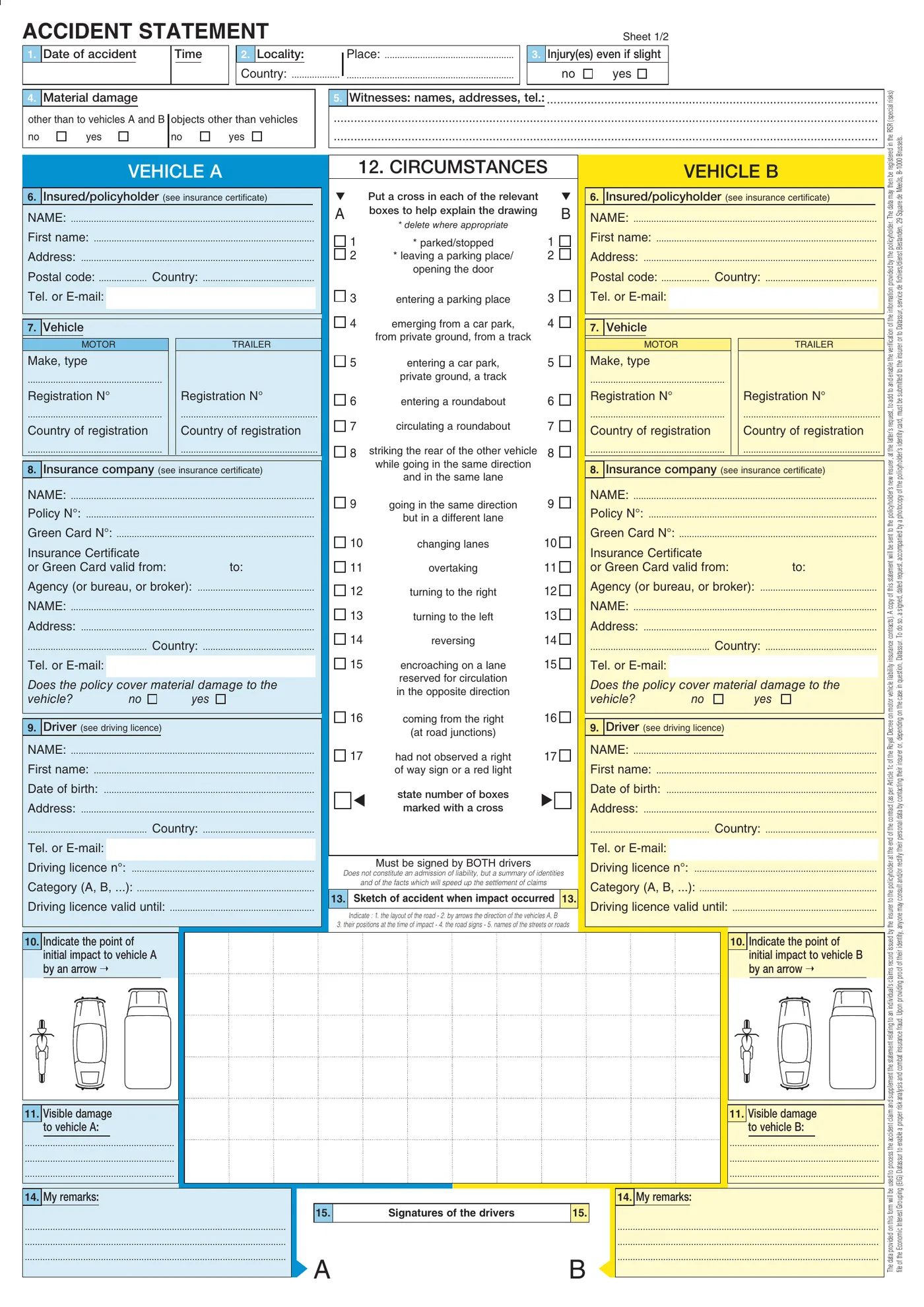
Form © C.E.A. (now Insurance Europe), edited by Assuralia, 2001 pattern. Shown here for illustration of the official layout; obtain your own copy from your insurer or rental company.
How to read it
- Blue column is vehicle A, yellow is vehicle B. Which car is which does not matter; agree it and stay in your column.
- Boxes 1 to 5 across the top are shared. Boxes 6 to 11 and 14 repeat on both sides. Boxes 12, 13 and 15 sit in the middle and need both of you.
- Pick a pin to see what the box records and how it applies to a rental car.
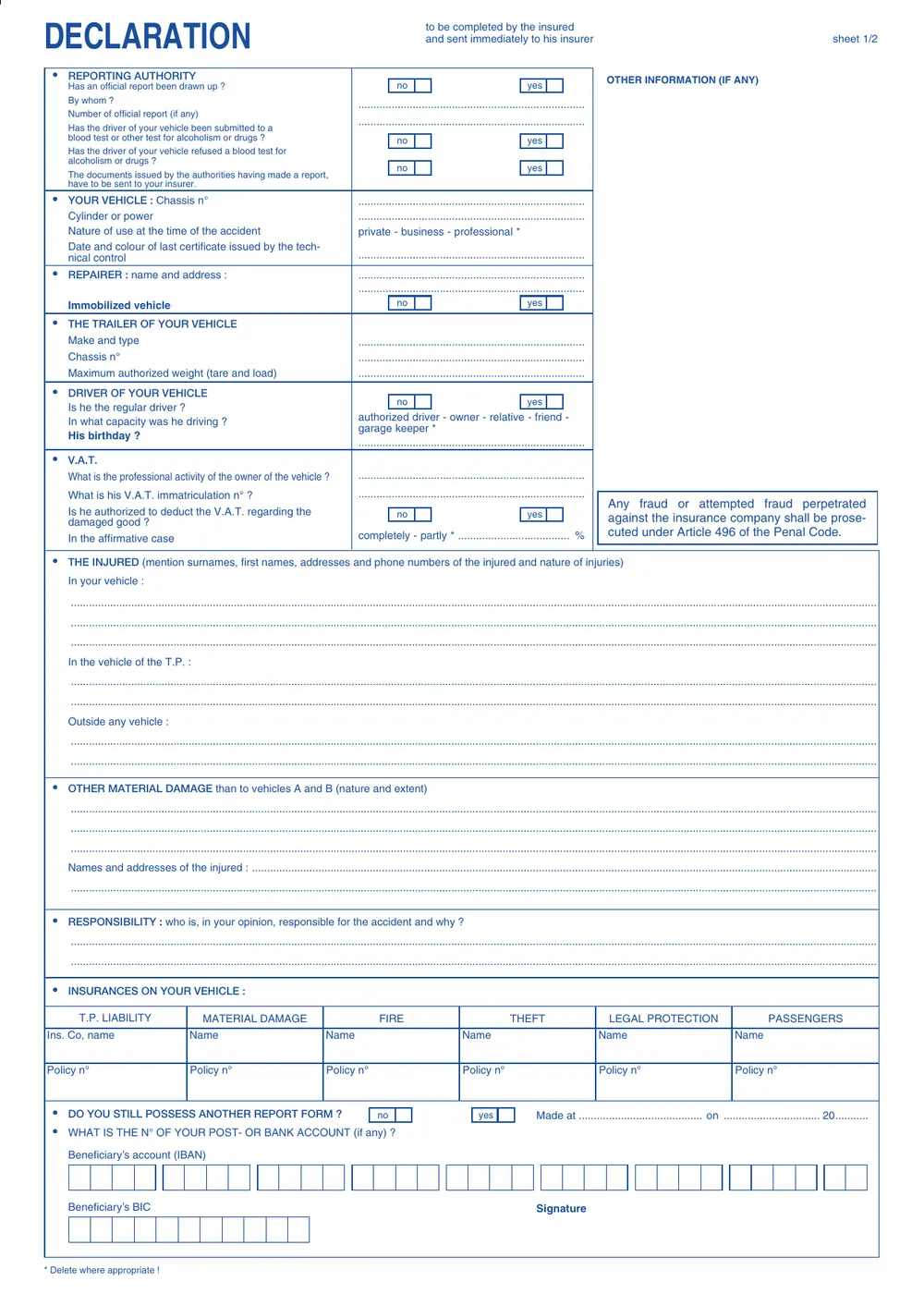
The back page is a separate declaration for your own insurer only: whether the police drew up a report, whether a breath or blood test was taken, who was injured, your view of responsibility, and payment details (CEA pattern form, back page). The other driver does not see it.
How do you complete it?
The form's own directions set four rules (CEA directions):
- One set of forms for two vehicles, two sets for three. It does not matter who supplies it.
- Ballpoint pen, pressing hard, so the carbon copy is legible.
- Sign it and have the other driver sign it, then hand over one copy and keep the other.
- "Under no circumstances alter anything on the face of the form" afterwards.
| Box | Printed heading | Content |
|---|---|---|
| 1 | Date of accident, time | Date and local time |
| 2 | Locality: place, country | Country, town, road, nearest marker or junction |
| 3 | Injury(ies) even if slight: no / yes | Any injury, however minor |
| 4 | Material damage other than to vehicles A and B; objects other than vehicles | Third vehicles and property |
| 5 | Witnesses: names, addresses, tel. | Independent witnesses |
| 6 | Insured / policyholder (see insurance certificate) | Holder of the policy; for a rental, the rental company |
| 7 | Vehicle: make, type, registration no., country of registration; trailer | From the registration documents |
| 8 | Insurance company: name, policy no., Green Card no., valid from / to, agency; does the policy cover material damage to the vehicle? | From the insurance certificate or Green Card |
| 9 | Driver (see driving licence): name, date of birth, address, licence no., category, valid until | From the driving licence |
| 10 | Point of initial impact: arrow on the pictogram | First point of contact |
| 11 | Visible damage | Factual list |
| 12 | Circumstances: 17 boxes; state number of boxes marked with a cross | Manoeuvre at the moment of impact, own column only |
| 13 | Sketch of accident when impact occurred | Road layout, direction arrows, position at impact, signs, street names |
| 14 | My remarks | Your own observations, including any disagreement |
| 15 | Signatures of the drivers | Both, last of all |
The CEA directions say to take box 8 from "your insurance documents (certificate or green card)" and box 9 from your driving licence. In a rental car the certificate or Green Card is normally with the vehicle documents; the policyholder is the rental company and you are the driver. An International Driving Permit, where carried, can be noted in box 14.
What do the 17 circumstance boxes mean?
Each line in box 12 names a manoeuvre. You mark those that applied to your own vehicle at the moment of impact, in your column; the other driver marks theirs. The wording of the standard English form (CEA pattern form):
- parked / stopped
- leaving a parking place, opening the door
- entering a parking place
- emerging from a car park, from private ground, from a track
- entering a car park, private ground, a track
- entering a roundabout
- circulating in a roundabout
- striking the rear of the other vehicle while going in the same direction and in the same lane
- going in the same direction but in a different lane
- changing lanes
- overtaking
- turning to the right
- turning to the left
- reversing
- encroaching on a lane reserved for circulation in the opposite direction
- coming from the right (at road junctions)
- had not observed a right of way sign or a red light
Below the list each column has a counter: "state number of boxes marked with a cross". The European Consumer Centre advises writing that number so that no box can be added after the copies are separated (ECC France).
Does signing mean admitting fault?
No. The form states that it "does not constitute an admission of liability, but a summary of identities and the facts which will speed up the settlement of claims" (CEA pattern form). ADAC confirms that the entries are not an acknowledgement of guilt (ADAC), and Insurance Europe calls signing "perfectly safe" as long as you keep a copy with the other party's signature (Insurance Europe).
Fault is decided afterwards by the insurers, under the law of the country where the accident happened (Your Europe, checked 2 September 2026). The same EU guidance adds: do not admit liability, and sign only if you fully understand what is written.
What if the other driver's form is in another language?
Use either copy. The CEA directions state that a form in the CEA pattern in another language "is identical with yours and you can therefore follow the translation from item to item (they are numbered for this purpose) on your own form" (CEA directions). Each driver writes in their own language. GDV publishes a translation booklet with the headings in ten languages (GDV, PDF).
Where can you get the form?
Insurance Europe directs drivers to their insurer (Insurance Europe); rental companies supply it with the vehicle documents. Insurer and motoring-club copies of the CEA pattern:
| Language | Source | Link |
|---|---|---|
| English, with directions for use | CEA pattern, USAA edition | |
| German plus ten translations | GDV | |
| German in 22 languages | GDV consumer site | dieversicherer.de |
| German, two-copy print | ÖAMTC | oeamtc.at |
| French | Allianz France | |
| Italian | Zurich Connect | |
| Spanish | Generali España |
A home-printed copy has no carbon sheet, so print two.
Is there a digital version?
Several countries have one, but each is restricted to locally registered and insured vehicles, which in practice excludes a visitor's home insurer and often a tourist altogether. Paper remains valid everywhere.
| Country | App | Status (2026) |
|---|---|---|
| France | e-constat auto (France Assureurs) | Since 1 December 2014; accidents in France, French-registered vehicles, no injuries; same legal value as paper (justice.fr) |
| Italy | CAI digitale via each insurer's app | Binding on all insurers from 8 April 2026 (IVASS Regolamento 56/2025); signature by SPID or CIE digital identity; paper remains valid (ACI) |
| Spain | Declaración iDEA (UNESPA) | One driver completes, the other confirms by code; sent to both insurers (MAPFRE) |
| Belgium | Crashform (Assuralia) | Built on the European Accident Statement (App Store) |
| Netherlands | MobielSchadeMelden | Dutch vehicles only (iCulture) |
What does your rental company require?
Rental terms turn the voluntary form into a contractual duty, usually with a police report and a deadline, and make the damage waiver conditional on compliance. The excess mechanics are in the rental car insurance guide. Published requirements of the main suppliers:
| Supplier | Published requirement |
|---|---|
| Sixt (global help centre) | Report any damage "immediately, by phone first, followed by written confirmation, regardless of how minor"; "a police report is required in all cases"; do not arrange repairs yourself (Sixt; UK version) |
| Europcar (FAQ, same text on its country sites) | Call 112 if anyone is injured, then roadside assistance; prepare a written accident or damage report with names, witnesses, plates, police file number and your account; hand it in at the station, "even in the event of minor damage, such as scratches" (Europcar) |
| Europcar Austria | European accident report "must be signed by all parties"; notify within 2 working days; where the other party's fault cannot be proven for lack of data, the renter is liable up to their protection level (Europcar AT) |
| Europcar Switzerland | Notify police and Europcar immediately, including single-vehicle accidents; European accident report plus the Europcar claim form (Europcar CH) |
| Hertz (UK FAQ) | Contact roadside assistance immediately; report to local authorities as required; a Vehicle Incident Report may be required on return (Hertz UK) |
| Hertz Greece | Inform the branch within 24 hours; police if another vehicle, injury or third-party damage; signed accident report within 48 hours; otherwise waiver products "may cease to be valid" (Hertz GR) |
| Guerin (Portugal) | Complete the European Accident Statement supplied with the contract, all fields, signed by all parties; police report if the parties disagree; claims usually closed within 30 working days (Guerin) |
Your own rental agreement is the binding text and may differ from these pages.
What the sources warn against
- Admitting fault on the form. It records facts; liability is assessed later under local law (Your Europe).
- Leaving the box 12 counter empty (ECC France).
- Signing before the page is complete, or signing a page you do not understand (Your Europe).
- Omitting the country of registration or the Green Card number, both listed by Insurance Europe among the details to record (Insurance Europe leaflet).
- Not photographing the scene and damage (ADAC, ANWB).
- Changing the signed page afterwards (CEA directions, LALUX).
- Skipping the form for a single-vehicle incident. The directions say it also covers own damage, theft and fire, and rental companies require it in those cases.
On a self-drive itinerary across several countries, a spare blank copy and a pen in the car cost nothing. Trips planned with Easy Escape have the form, the Green Card and the assistance number checked at handover.
FAQ
Is the European Accident Statement mandatory?
Not by law in most EU countries. Italy requires drivers to report accidents to their insurer on the approved form, and rental contracts across Europe make it a condition of the damage waiver. In a rental car, treat it as required.
What if the other driver refuses to sign?
The CEA directions say to call the police if you think it is in your interest, and ECC France gives the same advice. Complete your own column, record the refusal in box 14, photograph the scene, and tell your rental company; most require a police reference in that situation.
Which column do I fill in, A or B?
Either. The columns are identical. Agree with the other driver, then stay in your column for boxes 6 to 11 and 14, and mark only your side of box 12.
Do I need the form if nobody else was involved?
In a rental, yes. The directions state the form also covers own damage, theft and fire, and Europcar Switzerland and Guerin require it regardless of a counterparty.
Can I write in English on an Italian or Spanish form?
Yes. The boxes are numbered the same in every edition, so your entries sit in the right place. The other driver writes in their language.
How long do I have to send it in?
Set by your contract. Hertz Greece allows 48 hours and Europcar Austria 2 working days for rentals. For your own car in France, the contract deadline cannot be less than 5 working days under art. L113-2 Code des assurances.
Legal notice
- Not legal, insurance or financial advice. This article is general information for travellers and is not a substitute for advice from a lawyer, your insurer, your rental company or the police in the country where the accident happened. Do not rely on it as the sole basis for any decision.
- Law differs and changes. Road traffic, insurance and consumer rules vary between countries and are amended often. Facts here were checked against the listed sources on 27 October 2026 and may be out of date when you read them. Confirm current rules with the official bodies linked below.
- Contracts prevail. Your rental agreement and insurance policy set the deadlines and procedures that bind you and may be stricter than anything described here.
- Your own responsibility. Completing, signing or declining to sign any accident form is your decision and has consequences we cannot assess from a distance. If in doubt, record your position in box 14 and ask the police or your insurer.
- No liability. To the fullest extent permitted by law, Easy Escape Road Trips and its authors accept no liability for any loss, damage, fine, claim or cost arising from use of or reliance on this article, including any inaccuracy, omission or change in the law.
- Third-party content and links. The form shown is the CEA-pattern European Accident Statement, © C.E.A. (now Insurance Europe), edited by Assuralia, reproduced in reduced form for illustration and commentary. We are not affiliated with Insurance Europe, Assuralia or any insurer or rental company named. External links are for reference; we do not control their content.
- Emergencies. If anyone is injured, call 112 before anything else.
Sources and references
- CEA / Insurance Europe pattern form and directions for use (English)
- Insurance Europe: Accidents, information for consumers
- Insurance Europe leaflet: What to do if you have a road accident abroad
- Your Europe: Car insurance, accidents abroad (checked 2 September 2026)
- ECC France: Car accident in Europe (updated 5 May 2026)
- ADAC: Europäischer Unfallbericht
- GDV translation booklet
- GDV / dieversicherer.de: form in 22 languages
- ANWB: Aanrijding in het buitenland
- Brocardi: art. 143 Codice delle Assicurazioni Private
- ACI: Constatazione amichevole digitale
- Groupama: Délais de déclaration de sinistre (art. L113-2)
- justice.fr: Remplir un constat amiable, e-constat
- MAPFRE: Declaración iDEA
- LALUX: European accident report, mistakes to avoid (17 February 2026)
- RIS: §4 StVO Austria
- Sixt help centre: How do I report damage or an accident on my SIXT rental car?
- Europcar FAQ: What happens if the vehicle breaks down or if I have an accident?
- Europcar Austria: Damage services
- Europcar Switzerland: Damage management policy
- Hertz UK FAQ: Breakdown or accident
- Hertz Greece: During your rental
- Guerin: Accidents and assistance FAQ