Tolls in Europe: What Roads Cost and How to Pay (2026)
Europe charges for its motorways in three ways: pay-per-distance tolls at barriers or cameras (France, Italy, Spain, Croatia), a flat time-based vignette you buy before entering the motorway (Switzerland, Austria, Slovenia and most of Central Europe), and, in a third group that includes Germany and the Netherlands, no car tolls at all. Budget roughly EUR 7 to 10 per 100 km in the pay-per-distance countries (Tolls.eu) and EUR 10 to 40 per vignette country, and you will land close to reality.
If you grew up with Salik in Dubai or FASTag in India, none of this is conceptually new. Norway and the newest French motorways work exactly like Salik: cameras read your plate and the bill follows. The orange télépéage lanes in France are Europe's FASTag. The difference is that as a visitor you can do an entire trip with nothing but a contactless Visa or Mastercard, if you know which lane to pick.
Key Takeaways
- Vignettes for 2026: Austria EUR 12.80 for 10 days (ASFINAG), Slovenia EUR 16 for 7 days (Tolls.eu), Switzerland CHF 40 with no shorter option (ch.ch).
- French autoroutes average about EUR 9.50 per 100 km; Paris to Nice is roughly EUR 90 in tolls (about-france.com).
- Skipping a vignette is expensive: EUR 200 on the spot in Austria (EVZ), CHF 200 plus the vignette in Switzerland (ch.ch).
- France's newest motorways (A79, A13/A14) have no barriers at all. Pay online within 72 hours or the penalty climbs from EUR 10 to EUR 375 (service-public.gouv.fr).
- Portugal scrapped tolls on the Algarve's A22 and several other motorways from January 2025 (trans.info).
The Three Toll Systems at a Glance
Every country on a typical self-drive Europe route fits one of three buckets: distance-based tolls, a time-based vignette, or toll-free motorways. The map below shows which is which. Getting this mental model right is 80% of toll planning, because each bucket has one rule: pay as you go, buy the pass before you enter, or relax.
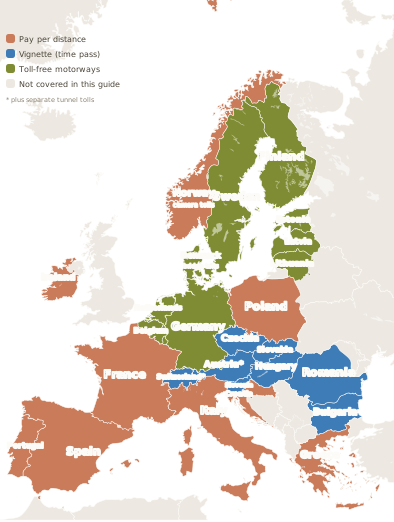
Two footnotes to the map. Germany genuinely has no car toll on the Autobahn (Tolls.eu). And Denmark's roads are free, but the Storebælt bridge costs DKK 395 one way at the standard 2026 rate (Storebælt) and the Øresund crossing to Sweden DKK 470 (Øresundsbron), so a Scandinavian loop needs a bridge budget even with zero tolls.
Vignette Countries: Buy Before You Enter
A vignette is a flat pass for the whole motorway network, bought before your wheels touch it. In 2026 every vignette country except Switzerland sells a digital version linked to your number plate, checked by camera. Buy only from official shops; reseller sites charge markups of several euros for the identical product.
| Country | Visitor option (2026) | Annual | Official shop | Caught without one |
|---|---|---|---|---|
| Austria | 1 day EUR 9.60 / 10 days EUR 12.80 | EUR 106.80 | shop.asfinag.at | EUR 200 on the spot (EVZ) |
| Switzerland | none, annual only | CHF 40 | via portal, Federal Customs | CHF 200 + the vignette (ch.ch) |
| Slovenia | 7 days EUR 16 / month EUR 32 | EUR 117.50 | evinjeta.dars.si | EUR 300 (Fuel-Prices.eu) |
| Czechia | 1 day CZK 230 / 10 days CZK 300 | CZK 2,570 | edalnice.gov.cz | camera-enforced |
| Slovakia | 1 day EUR 8.10 / 10 days EUR 10.80 | EUR 90 | eznamka.sk | camera-enforced |
| Hungary | 10 days roughly HUF 6,900 (Daily News Hungary; confirm at ematrica.nemzetiutdij.hu) | ~HUF 62,000 | ematrica.nemzetiutdij.hu | camera-enforced |
| Romania | 10 days EUR 6 | EUR 50 | roviniete, CNAIR | camera-enforced |
Three traps hide in that table. First, Switzerland has no short-term vignette: one day on a Swiss motorway costs the full CHF 40, which is why some Swiss Alps itineraries route around the border on the French A40 side. Second, Austria's 2-month and annual digital vignettes bought online by consumers only become valid on the 18th day after purchase under EU distance-selling rules; the 1-day and 10-day versions are valid immediately (ASFINAG). Third, Slovenia charges double for vehicles over 1.30 m at the front axle, which catches many campervans; check before a campervan trip.
One more cost sits on top of vignettes: Alpine tunnels. Austria charges section tolls, for example about EUR 11.50 one way on the Brenner A13 (ASFINAG), and the Mont Blanc and Fréjus tunnels between France and Italy passed EUR 56 for a one-way car ticket after the 2026 increase (TrasportoEuropa). Switzerland's Gotthard tunnel, by contrast, is covered by the vignette (ch.ch).
Pay-Per-Distance Countries: What Routes Actually Cost
In France, Italy, Greece and Croatia you pay for the kilometres you drive, which makes tolls a real line item on long routes. France averages about EUR 9.50 per 100 km for a car (Tolls.eu) and Italy about EUR 0.09 per km (travelinformation.eu). The table below gives verified 2026 examples you can budget against.
| Route | Distance | Tolls (car) | Source |
|---|---|---|---|
| Paris → Nice (A6/A7/A8) | ~935 km | ~EUR 90 | about-france.com |
| Paris → Bordeaux (A10) | ~580 km | ~EUR 61 | about-france.com |
| Paris → Geneva (A6 + A40) | ~610 km | EUR 58.40 | Lucky Way |
| Milan → Rome (A1) | ~570 km | ~EUR 43 | ItalyPlanner |
| Zagreb → Split (A1) | ~410 km | EUR 26.40 | HAC |
| Athens → Thessaloniki | ~503 km | ~EUR 30-37 | mydiodia |
Spain is the pleasant surprise of this bucket. Around 1,000 km of AP motorways went free when their concessions expired, including the Mediterranean AP-7 from the French border to Alicante (Vialtis); what still tolls in 2026 is mainly the Basque AP-8/AP-1 network and Galicia's AP-9 (Lucky Way). Portugal followed: the Algarve's A22 and several other ex-SCUT motorways have been toll-free for cars since 1 January 2025, with the A25 going free during 2026 (The Portugal News).
For an exact figure before you commit to a route, price it on the operator's own calculator: Sanef's journey pricer for northern France, autostrade.it for Italy, or TollGuru's Europe calculator for multi-country trips.
France Without Tolls: When It Works and When It Doesn't
Yes, you can drive France toll-free. The old routes nationales run parallel to almost every autoroute, and Google Maps will happily route you along them if you switch on "avoid tolls". The honest math: on a long route like Paris to Nice you save around EUR 90 but add roughly 2 to 4 hours, because N and D roads pass through towns with low speed limits (RAC).
Whether that trade is worth it depends on the day. Avoiding tolls on a 150 km hop through pretty country is free sightseeing. Avoiding them on a 900 km transfer is usually false economy: the RAC's assessment is that extra fuel from stop-start town driving, plus a possible extra overnight, eats much of the saving (RAC).
The smarter trick is the third option: France's genuinely free fast roads. The A75 "La Méridienne" runs 340 free kilometres from Clermont-Ferrand to Béziers, with only the Millau Viaduct to pay (about EUR 13.50 for a car in summer), and the A20 gives another 275 free kilometres from Vierzon to south of Brive (about-france.com). Build a Paris-to-Mediterranean route down the A20 or A75 and you get motorway speed at a fraction of the A6/A7 toll bill. Italy and Spain have milder versions of the same choice: the SS1 Via Aurelia along the Tuscan coast instead of the tolled A12, adding an hour or two per 200 km (ItalianTolls), and Spain's free autovías, which now cover most of the country.
At the Barrier: Lanes, Cards and the Help Button
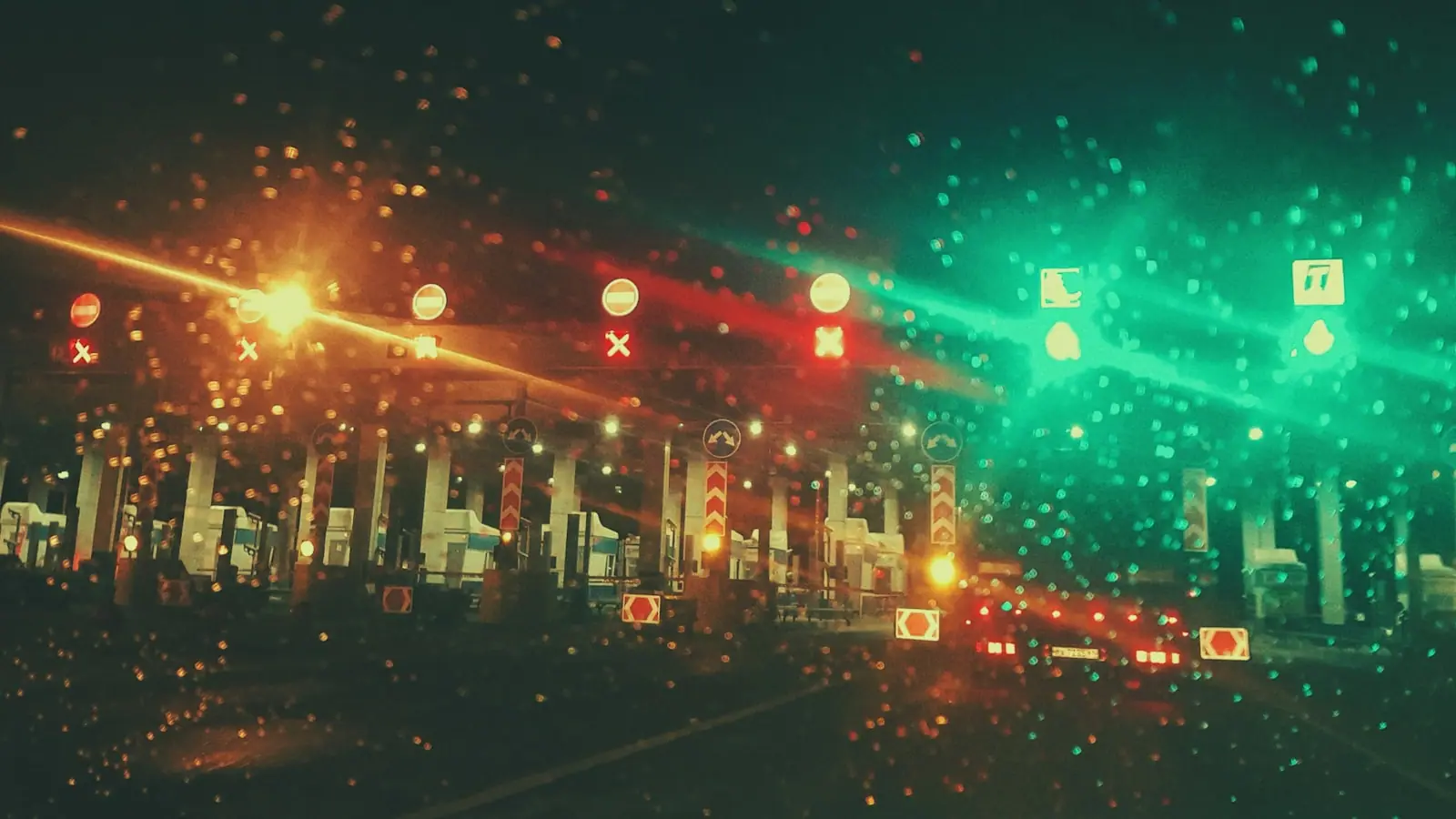
French toll plazas sort traffic by overhead symbols, and picking the right lane removes most of the stress. As a visitor with no tag, always aim for the green arrow.
| Symbol | Meaning | Use it? |
|---|---|---|
| Orange lowercase "t" | Télépéage tag holders only | No, unless you carry a tag |
| Green downward arrow | Every payment method | Yes, always safe |
| Card symbol / "CB" | Cards only | Yes, with chip Visa/MC |
| Coin symbol | Cash, machines give change | Backup |
| Red X | Lane closed | Never |
Lane meanings from Bison Futé and about-france.com. On most French routes the system is closed: take a ticket when you enter, insert it at the exit, pay the displayed amount (Eurotunnel LeShuttle). Italy works the same, with yellow Telepass lanes instead of orange (Autostrade per l'Italia).
On cards: chip-and-contactless Visa and Mastercard work at virtually every barrier in France, Italy and Spain. American Express is inconsistent at French péages, so never travel with Amex as your only card (francetravelplanner.com). This matters for GCC residents whose primary card is often Amex.
If something goes wrong, do not reverse out of the lane. Every machine has an intercom button, staff speak enough English, and an attendant can take payment or lift the barrier (francetravelplanner.com). In Italy the barrier opens anyway and the machine prints a "mancato pagamento" slip; pay it free of charge within 15 days at autostrade.it and nothing further happens.
Camera Tolls: The Salik Model Comes to Europe
A growing share of European tolling has no barriers at all, and this is where first-timers get hurt, because nothing physically stops you from driving through unpaid. France's A79 and the A13/A14 towards Normandy are "flux libre": gantries read your plate, and you must pay within 72 hours online at sanef.com or at a tobacconist. Miss the window and the surcharge ladder runs EUR 10, then EUR 90, then a EUR 375 fixed fine after two months, enforced against foreign plates too (service-public.gouv.fr).
Norway runs its entire network this way through AutoPASS. In a rental you do nothing at all: tolls bill automatically to the rental company, which recharges your card with an admin fee of roughly NOK 35 to 100 per pass (Life in Norway, AutoPASS). Portugal's remaining electronic-only stretches offer visitor fixes at the border: the EASYToll kiosk links your card to your plate for 30 days, or a rental comes with a Via Verde transponder (Via Livre).
The classic horror story is the Portuguese rental fine that arrives months later: the plate-based toll routes through the rental company, which re-bills your card with fees long after you flew home (The Barefoot Nomad). The fix is boring and effective: know which roads on your route are camera-tolled before you drive them, and pay the same evening. Our driving fines guide covers the wider family of surprises posted to your home address.
Rentals, Tags and Who Buys the Vignette
The vignette question in a rental has one rule: the car carries its home country's pass and nothing else. A Swiss-registered rental almost always has the CHF 40 vignette; an Austrian rental carries the Austrian one; confirm at the desk either way (tour-switzerland.ch). Pick up in Munich and drive to Vienna or Zurich, and buying both vignettes is on you; German border petrol stations sell the Austrian sticker, and both countries sell immediate-validity digital versions online (ASFINAG, ch.ch).
Personal toll tags (Bip&Go and Ulys in France, around EUR 2 per month of actual use plus a small activation fee, covering France, Spain, Portugal and optionally Italy) are excellent for European residents who drive down every year (Bip&Go, Ulys). For a visitor from Dubai or Mumbai on a one-off rental they rarely make sense: the tag ships to a home address in advance and links to an account, and a contactless card in the green-arrow lane does the same job. In Italy, ask at pickup whether the rental includes a Telepass device; policies vary by company, and using a yellow Telepass lane without one gets re-billed through the rental desk with a processing fee (ItalyPlanner).
What a Real Trip Costs: Three Worked Budgets
Tolls are predictable once you know the buckets, so budget them before you book, the same way you budget fuel. Here are three classic first-timer routes with itemized 2026 road charges for a car.
| Trip | Road-charge items | Total |
|---|---|---|
| Amsterdam → Paris → Geneva → Milan | NL/BE/DE free; French autoroutes incl. Paris–Geneva EUR 58.40 (Lucky Way); Mont Blanc tunnel one way EUR 56+ (TrasportoEuropa); Italian A5/A4 to Milan | ~EUR 160-210 |
| Munich → Vienna → Slovenia → Split | Austria 10-day vignette EUR 12.80 (ASFINAG); Slovenia 7-day EUR 16 (Tolls.eu); Zagreb–Split EUR 26.40 (HAC); optional Austrian tunnel tolls | ~EUR 55-75 |
| Paris → Loire → Bordeaux → San Sebastián | Paris–Bordeaux ~EUR 61 (about-france.com); A63 + short Basque AP-8 hop (Bidegi) | ~EUR 75-85 |
Notice the spread: the Alpine crossing costs three times the Balkan route, almost entirely because of one tunnel. This is exactly the kind of trade-off worth knowing before you fix your route; it is also the kind of thing we optimize when we plan a route for you.
A Five-Minute Toll Management Routine
Managing tolls across a two-week, four-country trip takes five minutes of setup and one habit. Before departure: price your long transfers on TollGuru or the operators' calculators, buy digital vignettes online the week before entry (remembering Austria's 18-day rule for long vignettes), and pack a chip Visa or Mastercard plus some euro coins. Remember that Google Maps' "avoid tolls" switch knows nothing about vignettes; it cannot route you out of needing one in Austria or Switzerland.
On the road, the one habit: any day you drive a camera-tolled road (French flux libre, Norwegian gantries, Portuguese electronic sections), pay online that evening and keep the confirmation. Fines in Europe follow you home; EU cross-border enforcement reaches foreign plates and rental records reach your card (service-public.gouv.fr). Paid on time, the whole system is cheap, fast and stress-free, which is exactly why the motorways are worth it on a first self-drive trip.
FAQ: Tolls in Europe
Do I need to pay tolls in Germany?
No. Germany has no toll for cars on the Autobahn; a planned car toll was struck down by the European Court of Justice in 2019 and never revived (Tolls.eu). You only pay in Germany for a handful of private tunnels, so a Germany-heavy route is one of Europe's cheapest to drive.
How much should I budget for tolls on a two-week trip?
Depends on the bucket mix. Vignette countries cost EUR 10 to 16 per country for a visit (ASFINAG, Tolls.eu); pay-per-distance countries run EUR 7 to 10 per 100 motorway km (Tolls.eu). A typical two-week, 2,000 km trip lands between EUR 60 and EUR 200.
Can I just avoid all tolls with Google Maps?
Partly. "Avoid tolls" reroutes you off pay-per-distance autoroutes at a cost of 2 to 4 extra hours on long routes (RAC), but it does not know about vignettes: enter Austria or Switzerland by motorway and you need the pass regardless of what the app says.
What happens if my card fails at a toll barrier?
Press the intercom button and stay in the car; staff can take payment or lift the barrier (francetravelplanner.com). In Italy the barrier opens automatically and you get a slip payable free within 15 days at autostrade.it. Never reverse in a toll lane.
Is a toll tag worth it for a visitor?
Usually not for a single rental trip. Tags like Bip&Go cost little (around EUR 2 per month used, Bip&Go) but ship to a home address and link to an account. A contactless Visa or Mastercard in the green-arrow lane covers the same ground; consider a tag only if you return to Europe yearly.
Are European tolls like Salik or FASTag?
The newest ones, yes. Norway's AutoPASS and France's flux-libre sections are plate-camera systems just like Salik, and télépéage tags work like FASTag. The difference: in Europe camera tolls are not deducted from a prepaid account automatically; on foreign plates you must pay online within a deadline, or the fine ladder starts (service-public.gouv.fr).
Sources and references
- ASFINAG: vignette and section tolls (Austria)
- ch.ch: Swiss motorway vignette
- Swiss Federal Customs: e-vignette
- DARS e-vinjeta (Slovenia)
- edalnice.gov.cz: Czech e-vignette price list
- eznamka.sk: Slovak e-vignette prices
- Nemzeti Útdíj: Hungarian e-vignette rates
- Daily News Hungary: 2026 vignette prices
- TollGuru: Romania vignette
- Tolls.eu: France, Germany, Slovenia
- about-france.com: driving and autoroute costs
- Lucky Way: France toll routes, Spain
- ItalyPlanner: autostrada tolls
- travelinformation.eu: Italy toll roads
- HAC: Croatian toll rates
- mydiodia: Athens–Thessaloniki tolls
- Vialtis: AP-7 and AP-2 toll removal
- Bidegi: Basque motorway tariffs
- The Portugal News: tolls ending in 2026
- trans.info: Portugal toll abolition
- Via Livre: electronic toll payment for visitors
- RAC: guide to toll roads in France
- ItalianTolls: avoiding high tolls in Italy
- Bison Futé: toll lane signs
- Eurotunnel LeShuttle: French toll roads explained
- francetravelplanner.com: paying French tolls
- Autostrade per l'Italia: toll calculation and unpaid tolls
- service-public.gouv.fr: free-flow tolls
- Sanef: free-flow payment
- ecologie.gouv.fr: péage flux libre
- EVZ: Austrian vignette fines
- Fuel-Prices.eu: Slovenia vignette
- AutoPASS: foreign vehicles in Norway
- Life in Norway: road tolls
- Storebælt: private prices
- Øresundsbron: prices
- TrasportoEuropa: Mont Blanc and Fréjus 2026 toll rise
- Bip&Go: électronic toll badge
- Ulys: toll badge plans
- tour-switzerland.ch: renting a car
- The Barefoot Nomad: Portugal toll roads
- TollGuru: Europe toll calculator