Low-Emission Zones in Europe: Sticker and Permit Guide 2026
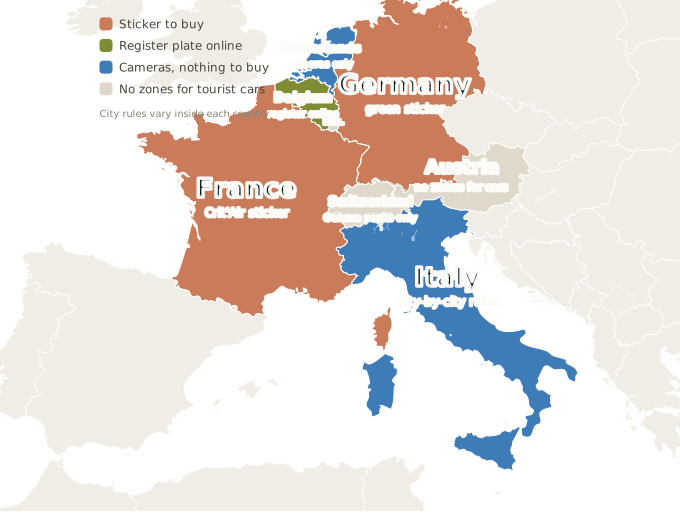
Low-emission zones are city areas where older, more polluting vehicles are banned or charged, and Europe now runs hundreds of them. The confusing part is that each country picked a different mechanism: France and Germany sell a windscreen sticker valid nationwide, Belgium wants your number plate registered online before you enter, Italy and the Netherlands just watch you with cameras, and Austria, Switzerland and Luxembourg ask nothing of a tourist car at all.
The rule of thumb that unlocks everything: what you must do depends on the country; where and whether you may drive depends on the city. A Crit'Air sticker is the same sticker in Paris and Lyon, but Paris is not fining anyone in 2026 while Lyon starts in July. This guide covers the central European core (France, Germany, Italy, Benelux, Austria, Switzerland); zones elsewhere, from Spain to Scandinavia, get their own guides on our journal.
Key Takeaways
- France's Crit'Air sticker costs EUR 3.81, or about EUR 4.91 posted abroad, only from certificat-air.gouv.fr; copycat sites charge EUR 30 to 60 for the same sticker (Ministère de la Transition écologique).
- Germany's green Umweltplakette costs EUR 5 to 20, is issued same-day at any TÜV or DEKRA station, and lasts the life of the car (DEKRA).
- In Brussels, Antwerp and Ghent even a fully compliant foreign car gets fined EUR 150 if the plate was not registered online; registration is free (ECC Belgium).
- The ring motorways around Brussels and Antwerp and Berlin's A100 sit outside the zones, so through-traffic needs nothing (lez.brussels, visitBerlin).
- Milan's Area C day ticket is EUR 7.50 and must be paid by midnight of the following day (YesMilano).
One Map, Four Different Systems
Before any city detail, fix the mental model: there are only four mechanisms, and each country in the region uses exactly one of them for tourist cars. Find your route's countries on the map, and you know what homework each one sets.
| Country | System | What a visitor does | Official source |
|---|---|---|---|
| France | National Crit'Air sticker, city-level bans | Order the sticker 3-6 weeks ahead | certificat-air.gouv.fr |
| Germany | National green sticker, ~40-60 city zones | Buy same-day at TÜV/DEKRA on arrival | uk.diplo.de |
| Italy | No sticker; each city its own camera zones | Check each city; pay Milan Area C online | comune.milano.it |
| Belgium | Camera zones + mandatory free registration | Register the plate online, per region | lez.brussels, lez.vlaanderen.be |
| Netherlands | Camera zones, diesel cars only | Nothing, unless driving an older diesel | milieuzones.nl |
| Austria | No zones for passenger cars | Nothing | umwelt-pickerl.at |
| Switzerland | Geneva only, during pollution peaks | Nothing on normal days | ge.ch |
| Luxembourg | No zones | Nothing | ACL |
If you know Salik in Dubai, the Belgian and Dutch systems will feel familiar: cameras read every plate, no sticker exists, and the computer decides. The French and German sticker systems have no GCC or Indian equivalent, which is exactly why they catch visitors.
First: Find Out What Category Your Car Is
Every scheme in Europe grades cars by their Euro emissions standard, so check your vehicle's class before checking any city rule. On an EU registration certificate the Euro standard sits in field V.9; rental cars carry the registration document on board, typically in the glovebox, so look there at pickup (FEBIAC). If V.9 is empty, the first-registration date decides: Euro 4 from January 2006, Euro 5 from January 2011, Euro 6 from September 2015 (RAC).
For France, fuel type matters as much as age. This is the full Crit'Air ladder (France.fr):
The practical reassurance first-timers need: a current rental car is nearly always diesel Euro 6 or petrol Euro 6, which is Crit'Air 2 or 1, allowed in every French zone and every German, Belgian and Dutch zone. The rules mostly bite owners of older cars, and drivers who skip the paperwork.
France: One Sticker, Different Rules in Every City
France's ZFE zones survived their 2026 near-death experience. Parliament voted to abolish them in April, the Constitutional Council struck the vote down on 21 May 2026, and the zones remain fully in force (The Local). Anything you read about French zones being scrapped is out of date.
The sticker is national and permanent, so order it once and it covers Paris, Lyon, Grenoble, Strasbourg and Montpellier alike. Order only at certificat-air.gouv.fr: EUR 3.81, about EUR 4.91 posted to a foreign address, arriving in 10 to 14 working days, up to six weeks in summer (France Stickers). The ecology ministry has formally warned about lookalike sites charging EUR 30 to 60 for the identical sticker (ecologie.gouv.fr). If time runs short, the emailed confirmation PDF acts as valid proof while the sticker is in the post, for foreign vehicles too (Service-Public).
Where the rules actually bite in 2026:
| City | Banned in 2026 | Enforcement reality |
|---|---|---|
| Paris (Grand Paris) | Crit'Air 3+ since 2025 | No fines through 2026, pedagogical phase (Roole) |
| Lyon | Crit'Air 3, 4, 5 | Fines for Crit'Air 3 from 1 July 2026 (Selectra) |
| Grenoble | Crit'Air 3, 4, 5, weekdays 7:00-19:00 | Fines after 30 June 2026 (Caroom) |
| Strasbourg | Crit'Air 3+, 24/7 | Camera enforcement rolling out (cartes-2-france) |
| Montpellier | Crit'Air 3, 4, 5 | (Revue Automobile) |
The fine is EUR 68, dropping to EUR 45 if paid within 15 days (Honest John). Boundaries matter more than most guides admit: the Paris zone runs to the A86 motorway but the A86 itself is excluded, while the boulevard périphérique is inside the zone (paris.fr). In Lyon, the M6/M7 through-corridor and the Bonnevay ring are excluded, so transit traffic on the motorway needs no sticker (Green-Zones).
Germany: The Simplest System, With One Stuttgart Exception
Germany runs the friendliest scheme for a visitor. One green Feinstaubplakette covers every Umweltzone in the country, costs EUR 5 to 20, never expires for that vehicle, and can be bought on arrival with no appointment: any TÜV, DEKRA or licensed garage issues it in about twenty minutes against the registration document (IamExpat). DEKRA also ships abroad if you prefer to sort it before flying (DEKRA). Driving a zone without the sticker costs EUR 80 to 100, and it applies even to a parked car (RAC).
Two useful boundary facts. Autobahns are excluded from the zones by design: Berlin's Umweltzone covers the area inside the S-Bahn ring, and the A100 city motorway through Berlin explicitly needs no sticker (visitBerlin). And Stuttgart is the national outlier: on top of the green-sticker rule, the city bans diesel Euro 4 outright and diesel Euro 5 in an inner zone; only diesel Euro 6 drives everywhere in Stuttgart (stuttgart.de).
Italy: No Sticker Anywhere, a Different Rulebook in Every City
Italy never adopted a sticker. Instead, each city and region draws its own camera-enforced zones, which makes Italy the country where checking your specific destination matters most (urbanaccessregulations.eu is the canonical lookup).
Milan runs the two zones road-trippers actually meet. Area B covers most of the city at around 188 camera gates and simply bans older vehicles, currently diesel Euro 4 and older plus petrol Euro 2 and older, extending to petrol Euro 3 from 1 October 2026; a compliant car enters free with no registration needed (comune.milano.it). Area C is the historic-centre congestion charge on top: EUR 7.50 per weekday entry, payable online until midnight of the following day; miss it and the fine is about EUR 165 (YesMilano). The tangenziale ring motorways sit outside Area B, and park-and-ride garages at metro ends (Lampugnano, Famagosta, San Donato, Sesto) make skipping both zones easy (areacmilano.it).
Rome runs the fascia verde LEZ: through October 2026 it bans petrol up to Euro 2 and diesel up to Euro 3, with the stricter Euro 4/5 diesel bans postponed (urbanaccessregulations.eu). And across the Po Valley (Lombardy, Piedmont, Veneto, Emilia-Romagna), winter weekday bans on older diesels run October to April (CDR Italia). None of this touches a Euro 6 rental.
Italy's separate trap, the camera-enforced ZTL zones in historic centres, works on permits rather than emissions; our driving restrictions guide covers ZTLs in depth.
Belgium: Register the Plate or Get Fined While Fully Compliant
Belgium is where compliant drivers get fined, because the system checks registration, not just emissions. Brussels, Antwerp and Ghent each run a camera LEZ, there is no sticker, and every foreign-plated vehicle must be registered online, free, even when the car meets every standard. The European Consumer Centre documents exactly this: foreign drivers in fully compliant cars fined EUR 150 because the plate was not in the database (ECC Belgium).
Two systems, not one: lez.brussels for Brussels, lez.vlaanderen.be via Slim naar Antwerpen for Antwerp and Ghent together. A Brussels registration does nothing in Antwerp and vice versa. The deadlines differ too: Brussels allows registration up to five days after first entry, Flanders within 24 hours of entry (lez.brussels, Stad Gent). Standards in 2026: Brussels needs diesel Euro 6 or petrol Euro 3; Antwerp and Ghent stayed at diesel Euro 5 and petrol Euro 2 after Flanders postponed its tightening (Ayvens). Older cars can buy day passes, EUR 35 in Antwerp and EUR 45 in Ghent, capped at eight days a year (visit.gent.be).
Now the detail that saves through-travellers entirely: the motorway rings are outside the zones. Brussels' R0 ring is not part of the LEZ (lez.brussels), and Antwerp's zone covers the centre plus part of Linkeroever while the bordering ring motorways stay exempt, Kennedy tunnel included; only the Waaslandtunnel lands you inside the zone (VAB). Drive Amsterdam to Bruges on the motorway past Antwerp and Brussels, never leave it, and you need no registration at all. The danger is the fuel-stop exit your navigation app suggests: one wrong exit off the ring puts an unregistered car in camera range. If in doubt, register anyway; it is free.
Wallonia, meaning Liège, Namur and Charleroi, shelved its planned zones; southern Belgium has no LEZ in 2026 (urbanaccessregulations.eu).
The Easy Four: Netherlands, Austria, Switzerland, Luxembourg
The Netherlands runs camera-only milieuzones in Amsterdam, Utrecht, Arnhem and The Hague, and they apply to diesel cars only: green zones admit diesel Euro 4 and newer, blue zones Euro 5 and newer. Petrol, hybrid, LPG and electric cars enter every Dutch zone with nothing to buy, register or display (milieuzones.nl). The Dutch zero-emission zones launched in 2025 apply to trucks and delivery vans, not tourist cars (business.gov.nl).
Austria's IG-L environmental sticker applies only to trucks; passenger cars are explicitly exempt, so there is nothing to do in Vienna, Salzburg or Graz (umwelt-pickerl.at). Where you will meet IG-L is the reduced 100 km/h limit on motorway stretches near cities, where speeding fines run higher.
Switzerland has no national zones. Geneva alone runs the Stick'AIR scheme, activated only on declared pollution-peak days, and it officially recognizes the French Crit'Air sticker as equivalent (ge.ch). On a normal day you drive into Geneva with nothing. Luxembourg has no zones at all (ACL).
Rental Cars: What Is Already Sorted and What Is Not
A rental picked up in the country you drive in is usually pre-equipped: French fleets carry Crit'Air stickers, German fleets the green Plakette (France Stickers, Indigo Car Hire). Confirm on the windscreen at pickup, because the fine lands on the driver.
The genuine trap is the cross-border rental. Only the vehicle's keeper can order a Crit'Air sticker, and non-French rental companies generally do not, so a Munich or Zurich rental usually cannot legally enter Strasbourg's or Lyon's zone at all; plan the French legs of a Western Europe route around that, or pick the car up in France. Belgian registration, by contrast, anyone can do online with the plate number, so that one is on you and takes five minutes. When a zone fine does reach the rental company, expect an admin fee on top, around EUR 30 at the major firms (Hertz), the same pattern as toll and speeding fines.
Your Pre-Departure Timeline
Google Maps flags some zones with a small "Z" warning but has no avoid-zones routing and incomplete coverage, so do not outsource this to the app (Honest John). The official interactive map of every zone in Europe lives at urbanaccessregulations.eu. The homework, in order:
This is precisely the kind of homework we fold into every route we plan: when your itinerary is fixed, the zone list, the sticker orders and the registration links are known weeks before you fly. It is also, frankly, a reason many first-timers from Dubai or Mumbai keep their self-drive route out of big-city centres entirely: park at the ring, ride the metro in, and the whole topic disappears.
FAQ: Low-Emission Zones in Europe
Do I need an emission sticker for the Netherlands or Belgium?
No sticker exists in either country. The Netherlands needs nothing at all from petrol, hybrid or electric cars and only restricts older diesels (milieuzones.nl). Belgium needs a free online plate registration before driving into Brussels, Antwerp or Ghent, done separately for Brussels and Flanders.
Can I drive past Antwerp or Brussels without registering?
Yes, if you stay on the motorway. Antwerp's ring and the Kennedy tunnel corridor sit outside the LEZ, as does the Brussels R0 ring (lez.brussels, VAB). The risk is leaving the ring for fuel or a hotel; registration is free, so when in doubt, register.
Is my rental car already allowed everywhere?
Almost always, by emissions: a 2026-fleet rental is Euro 6, which clears every ban in this guide. What may be missing is paperwork: a French rental carries its Crit'Air, but a German or Swiss rental cannot get one, and Belgian registration is never pre-done for you (France Stickers).
What happens if I drove into a zone unprepared?
Belgium and Flanders allow late registration, five days and 24 hours respectively, so register immediately and you are covered (lez.brussels). Milan's Area C accepts payment until midnight the next day (YesMilano). French and German stickers cannot be backdated; if a fine comes, paying a French one within 15 days cuts it to EUR 45.
Do Austria and Switzerland have low-emission zones?
Not for tourist cars. Austria's sticker scheme applies to trucks only (umwelt-pickerl.at), and Switzerland's single scheme in Geneva activates only on pollution-peak days, accepting the French Crit'Air sticker when it does (ge.ch).
Where do I check the exact zone boundaries?
The EU-supported portal urbanaccessregulations.eu maps every zone in Europe with per-city pages, and each scheme's official site (paris.fr, berlin.de, lez.brussels, comune.milano.it) publishes the definitive boundary map. Do not rely on navigation apps to warn you.
Sources and references
- Service-Public.gouv.fr: Crit'Air for foreign vehicles
- Ministère de la Transition écologique: Crit'Air scam warning
- The Local: Constitutional Council keeps ZFEs
- paris.fr: the Paris ZFE
- Roole: no Paris ZFE fines in 2026
- Selectra: which ZFE cities fine in 2026
- Green-Zones: Lyon zone boundaries
- France.fr: Crit'Air classes
- France Stickers: delivery times and digital proof
- Honest John: Crit'Air fines
- RAC: German emissions sticker
- DEKRA: sticker shipping abroad
- IamExpat: buying the Umweltplakette
- visitBerlin: Berlin environmental zone
- stuttgart.de: Stuttgart diesel bans
- Comune di Milano: Area B
- YesMilano: driving and Area C
- areacmilano.it: Area B boundaries and P+R
- urbanaccessregulations.eu: Rome and all zones
- CDR Italia: Po Valley diesel bans
- lez.brussels: zone, registration and deadlines
- Slim naar Antwerpen: foreign vehicle registration
- Stad Gent: LEZ registration
- ECC Belgium: LEZ fines for foreign drivers
- VAB: Antwerp LEZ questions
- Ayvens: Belgian LEZ standards 2026
- visit.gent.be: Ghent day passes
- milieuzones.nl: Dutch zones
- business.gov.nl: zero-emission zones
- umwelt-pickerl.at: Austrian IG-L sticker
- ge.ch: Geneva Stick'AIR
- ACL: no zones in Luxembourg
- FEBIAC: reading the Euro standard from V.9
- RAC: Euro standards by date
- Hertz: fine processing fees
- Honest John: navigation apps and LEZ warnings
- urbanaccessregulations.eu: interactive zone map